
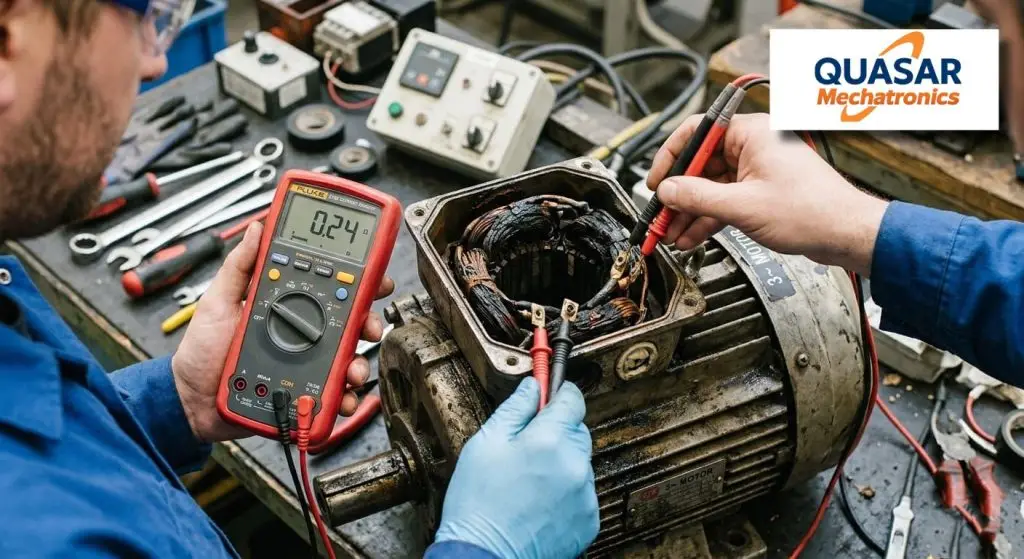
Whether you are managing a high-capacity Sewage Treatment Plant (STP) or maintaining industrial hydraulic systems, a sudden pump failure is more than just a nuisance—it’s a threat to your operational timeline. When the control panel trips or the motor hums without turning, the problem usually lies deep within the copper windings.
Before you pull the unit for a costly replacement, you can diagnose the issue yourself in minutes. A simple multimeter is often all you need to determine if a motor is salvageable or if it’s suffered a terminal “burnout.” This guide walks you through the professional sequence for testing insulation integrity and phase balance.
1. Ensure Safety First
Testing electrical components requires strict adherence to safety protocols to prevent shocks or equipment damage.
Switch OFF the main power supply at the breaker.
Isolate the pump by disconnecting its leads from the control panel.
Discharge any stored voltage in capacitors (especially in single-phase units) using a resistor or a specialized discharge tool.
2. Identify Pump Terminals
Open the terminal box on the motor. The configuration tells you what to test:
Single-phase: Usually features 2 or 3 terminals (Common, Start, and Run).
Three-phase: You will see three distinct terminals typically labeled U, V, and W.
3. Set Multimeter to Resistance (Ω) Mode
Turn your multimeter dial to the Ohms (Ω) setting. If your meter isn’t auto-ranging, set it to the lowest scale (usually 200Ω) for winding tests, as motor resistance is typically quite low.
4. Check Winding Resistance (Phase-to-Phase)
This test checks if the internal coils are intact and balanced. For a 3-phase pump, measure the resistance between:
U – V
V – W
U – W
✅ Normal Condition: All three readings should be almost equal (e.g., 2.4Ω, 2.5Ω, 2.4Ω).
Open Winding : The meter shows “OL” (Over Limit) or very high resistance, indicating a broken wire.
Short Circuit: The meter shows 0.0Ω or near-zero resistance, meaning the insulation has melted and wires are touching.
Partial Damage: Significant inequality between readings suggests the winding is degrading.
5. Check Insulation to Earth (Body Test)
This is the “Ground” test. It determines if the electrical path is leaking into the metal frame of the pump—a common cause of frequent panel tripping in STP environments.
Place one probe on a terminal (U, V, or W).
Place the other probe on a clean, unpainted spot on the motor body or the earth bolt.
✅ Normal: The meter should read Infinite / OL. This means there is no path between the electricity and the frame.
❌ Fault: Any numerical reading indicates an insulation failure or earth leakage.
6. Continuity Check
Switch your multimeter to Continuity Mode (the icon that looks like a sound wave).
Touch the probes to the ends of the same winding.
A “beep” confirms twinding path is continuous and not physically snapped.
7. Visual Signs of Winding Failure
Sometimes the multimeter only confirms what your senses already suspect. Look for:
Burnt smell: A sharp, acrid odor of burnt varnish.
Blackened winding: Visible charring or discoloration of the copper coils.
Moisture: Water or sludge inside the motor (common if seals fail in submerged STP pumps).
Panel Behavior: The breaker or OLR (Overload Relay) trips immediately upon startup.
✅ Pro Tips for Maintenance
Manufacturer Data: Always compare your Ω readings with the manufacturer’s datasheet for that specific motor model if available.
The Megger Advantage: While a multimeter is great for a quick check, use a Megger (Insulation Tester) for a more accurate high-voltage “stress test” of the insulation.
Dry Before Testing: If a pump was submerged, dry the motor thoroughly (using a heat lamp or oven) before testing; moisture can cause a temporary “false” earth fault reading.
Conclusion
A pump is the heart of your automation system, and understanding its “pulse” through a multimeter is a vital skill for any technician or plant operator. By systematically checking for open circuits, shorts, and earth leakages, you can move from guesswork to precision maintenance.
Regular testing doesn’t just identify failures—it prevents them. If your readings are starting to drift, you can schedule a rewind before a total burnout causes a catastrophic system shutdown. Keep your tools calibrated, your safety gear on, and your pumps running at peak efficiency.