
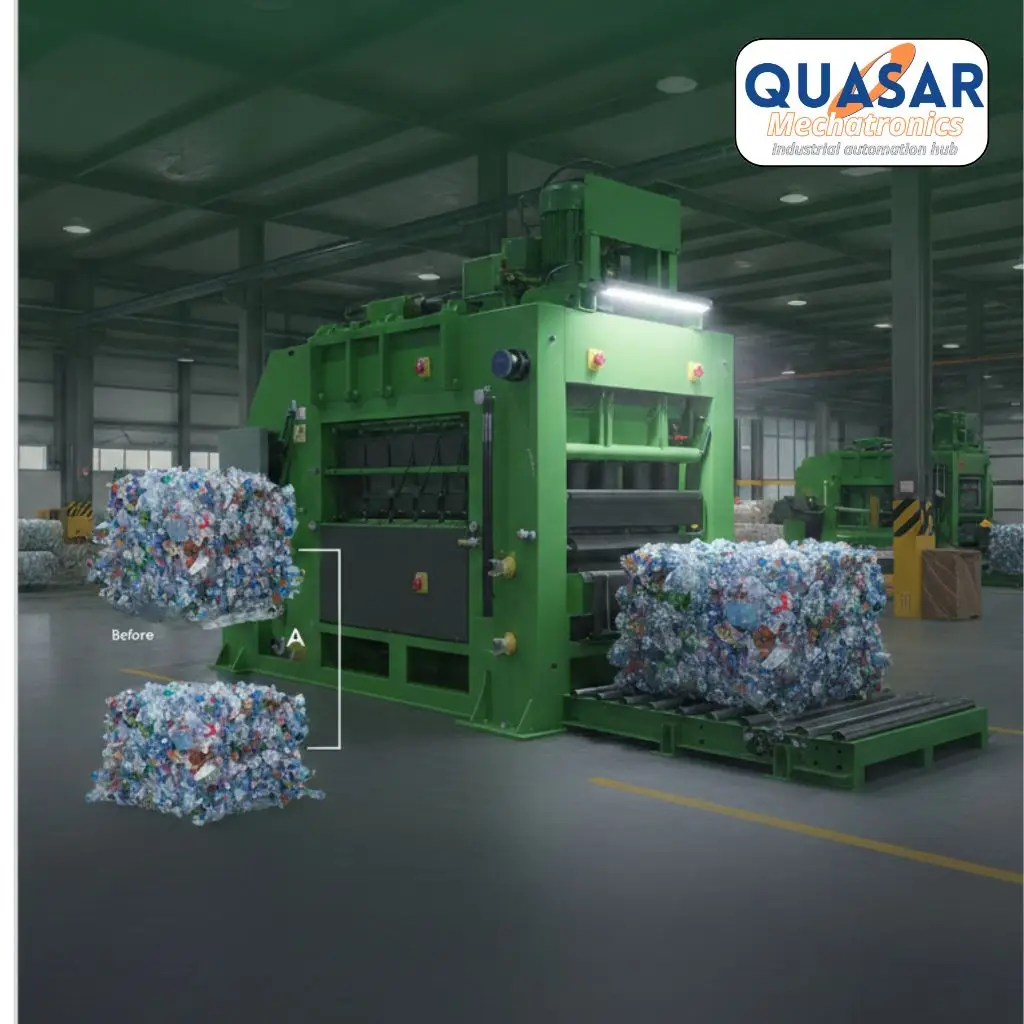
At its core, a PET Bottle Baling Machine is a heavy-duty industrial compactor designed to solve one of recycling’s biggest hurdles: volume. PET bottles are incredibly light but take up massive amounts of space because they are mostly filled with air. To make transporting and processing these bottles economically viable, they must be transformed from loose, chaotic piles into dense, stackable bricks called bales.
How the Pressing Process Works
The transformation from a loose bottle to a high-density bale happens in a few high-pressure stages:
-
Feeding & Leveling: Bottles are loaded into a large hopper—either manually or via a conveyor belt. Modern machines use sensors to ensure the “charge” is level before pressing.
-
Pre-Compression: Many horizontal balers use “pre-press” flaps or a vertical ram to push the bottles down, removing the initial “fluff” and preparing the material for the main stroke.
-
The Main Crush: A massive hydraulic cylinder, known as the main ram, moves forward with anywhere from 50 to 200 tons of force. This force doesn’t just flatten the bottles; it overcomes the structural integrity of the plastic, causing the bottles to interlock and collapse.
-
Pressure Holding: Once fully compressed, the ram holds its position for a few seconds. This “dwell time” allows the plastic to settle, preventing the bale from “springing back” when the pressure is released.
-
Tying & Ejection: While under pressure, high-tension wires or straps are wrapped around the block. The ram then retracts, and the finished bale—now weighing up to 500kg—is pushed out of the machine.
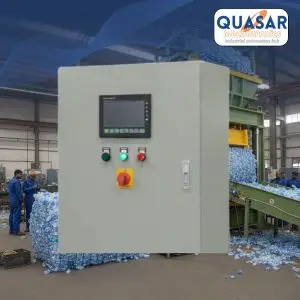
The Intelligence of Compaction: Integrating PLC Panels
While the hydraulics provide the brute force, the Programmable Logic Controller (PLC) Panel provides the intelligence. In high-output facilities, manual levers are replaced by a centralized control hub that manages every millisecond of the machine’s operation.
Precise Hydraulic Orchestration
A PLC panel is integrated directly with the machine’s solenoid valves. Instead of an operator guessing when a bale is “tight enough,” the PLC uses pressure transducers to measure the exact resistance of the plastic.
-
Variable Pressure Logic: The PLC can be programmed to apply different pressures for different materials (e.g., higher pressure for thick HDPE detergent bottles and lower for thin PET water bottles).
-
Speed Control: The PLC manages the ram’s approach speed—fast for empty space and slow for maximum torque during the final crush—optimizing cycle times.
Sensor Integration & Safety
The PLC acts as a “safety supervisor” by monitoring a network of digital and analog inputs:
-
Limit Switches: These tell the PLC exactly where the ram is, preventing it from over-extending and damaging the cylinder seals.
-
Safety Interlocks: If a hopper door is opened or an emergency stop is pressed, the PLC kills the power to the hydraulic pump in milliseconds, far faster than a human could react.
-
Oil Temperature Monitoring: If the hydraulic oil gets too hot during heavy use, the PLC can automatically trigger a cooling fan or pause the cycle to protect the machine’s “heart.”
HMI: The Human Interface
Modern PLC integration usually includes an HMI (Human-Machine Interface)—a touchscreen where operators can:
-
Adjust bale length and density.
-
View real-time diagnostics (e.g., “Sensor 4 Blocked”).
-
Track production data, such as how many bales were produced in a shift.
Why Choose Quasar Mechatronics for Your Automation?
At Quasar Mechatronics, we specialize in the “brain surgery” of industrial machinery. We design and integrate custom PLC panels specifically for hydraulic baling systems, ensuring your machines run faster, safer, and with less downtime.
we don’t just build panels; we engineer integrated solutions. Our PLC programming is tailored to the specific mechanical tolerances of your baling equipment, ensuring maximum throughput with minimal wear and tear
-
Custom Logic: Tailored code for your specific machine dimensions.
-
Remote Monitoring: Optional IoT integration to check your machine’s health from your phone.
-
Industrial Durability: Panels built to withstand the dusty, high-vibration environments of recycling plants.
Ready to upgrade your waste management system? Let’s discuss how our PLC integration can increase your throughput.
Transform your recycling operations with smart automation.
-
Phone: +91 9585324571 | +91 9585306006
-
Email: sales@quasarmechatronics.com
-
Address: Thudiyalur , Coimbatore, Tamil Nadu, India