
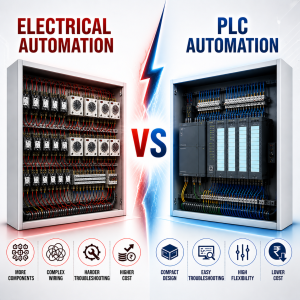
 Why Modern Industries Are Moving Beyond Conventional Panels
🔍 Introduction
Industrial automation has evolved rapidly, but many facilities still rely on conventional electrical panels built on relays, timers, and hardwired logic. While these systems worked in the past, today’s demand for efficiency, flexibility, and cost control is pushing industries toward PLC (Programmable Logic Controller) automation.
So, what really makes PLC panels superior? Let’s break it down.
🔴 Electrical Automation (Conventional Panels)
Electrical automation is based on hardwired control systems, where every function depends on physical components.
⚙️ How it Works
- Relays control logic
- Timers and counters are separate hardware devices
- Each function requires dedicated wiring and components
❗ Key Limitations
1. Component Explosion = High Cost 💸
Every timer ⏱️ and counter 🔢 is a physical device.
👉 Need 10 timers? → Install 10 timers
👉 Need 20 counters? → Install 20 counters
Now imagine scaling a system…
The panel size, wiring, and cost increase drastically.
2. Bulky Panels & Complex Wiring 🧵
More components mean:
- Larger panels
- Dense wiring
- Higher installation cost
- Increased chances of wiring errors
3. Difficult Troubleshooting 🛠️
Fault finding is manual:
- Check each relay
- Trace each wire
- Identify faulty component
👉 This leads to long downtime and production loss
4. Zero Flexibility 🔒
Any modification requires:
- Rewiring
- Adding new hardware
- Stopping operations
👉 Not suitable for modern dynamic industries
🟢 PLC Automation (Smart Control Panels)
PLC automation replaces physical logic with programmable intelligence.
⚙️ How it Works
- Logic is written in software
- Functions are executed inside the PLC
- Minimal hardware dependency
🚀 Key Advantages
1. Built-in Timers & Counters 💡
A typical PLC comes with:
✅ 250+ Timers (built-in)
✅ 250+ Counters (built-in)
👉 No need for separate devices
This alone can save huge cost.
💥 Real Comparison
| Function Requirement | Electrical Panel | PLC Panel |
|---|---|---|
| 10 Timers | 10 Devices | Programming |
| 50 Counters | 50 Devices | Programming |
| Panel Size | Large | Compact |
| Cost | High | Optimized |
👉 Think of the savings in hardware, wiring, and maintenance.
2. Compact & Clean Design 📦
- Less wiring
- Smaller panels
- Organized layout
- Professional finish
3. Easy Troubleshooting 🔍
PLCs provide:
- Error codes
- Fault diagnostics
- Real-time monitoring
👉 Problems can be identified within seconds
4. Flexibility & Scalability 🔄
Need to modify logic?
👉 Just update the program
No rewiring. No downtime.
5. Long-Term Cost Efficiency 💰
While PLC may seem like an investment initially:
- Saves hardware cost
- Reduces downtime
- Minimizes maintenance
👉 Lower total cost of ownership
⚡ Electrical Panel vs PLC Panel – The Core Difference
👉 Electrical Panel = Hardware-Based Logic
👉 PLC Panel = Software-Based Intelligence
🧠 Final Insight
In electrical automation:
More functions = More components = More cost
In PLC automation:
More functions = Just programming = Smart efficiency
🚀 Conclusion
The shift from electrical automation to PLC automation is not just an upgrade — it’s a strategic decision.
✔ Reduce cost
✔ Save space
✔ Improve efficiency
✔ Gain flexibility
👉 Industries that adopt PLC today are building future-ready operations
📞 CALL US
Upgrade your automation with Quasar Mechatronics
📲 Call: 9585324571
📧 Email: sales@quasarmechatronics.com
🌐 Website: www.quasarmechatronics.com